
Strong body, younger brain
Resistance training keeps your brain healthy as you age - and you don't have to lift heavy to benefit!

In Get stronger, live longer, I summarised research that found a significant association between greater muscle strength, and longer life expectancy. That’s all very well, but for the vast majority of people, living longer is only an attractive prospect if they’re able to maintain their cognitive capacity. Fortunately, having a stronger, more muscular body is also associated with better cognitive function and lower risk of developing dementia.
OK, so how much strength training is enough to reap these benefits? Is it really a case of “lift heavy, or don’t bother”, as so many online ‘health influencers’ claim, or is moderate-intensity strength training good enough? Do you need to go to a gym and work out on weights machines, or can you get results using your own body weight, or simple, cheap equipment that you can use in your own home?
A study published in GeroScience in February 2026, has helped to answer these questions. In a nutshell, both moderate intensity and heavy resistance training slowed down brain aging in healthy older adults, and after two years, the moderate intensity exercise group had actually slowed down their brain aging by slightly more than the heavy resistance training group.
The participants were 309 cognitively and physically healthy Danish adults, aged between 62 and 70, who were enrolled in the Live Active Successful Aging (LISA) trial. Participants were randomised into three groups:
The Heavy Resistance Training group attended three supervised sessions per week at a training centre for one year, performing a one hour, whole-body progressive resistance training program using weights machines, building up to weights approximating 70–85 per cent of participants’ one-repetition maximum (1RM) - that is, the heaviest weight that could be lifted just once, for each exercise.
The Moderate Intensity Training group attended one hour-long supervised session per week, and were instructed to perform two additional unsupervised home-based sessions per week, for one year. Their whole-body progressive resistance training program used body weight and resistance bands, at 50-60 per cent of 1RM.
The control group was instructed to continue with their usual level of physical activity, performing less than one hour of strenuous exercise per week.
Participants underwent a resting-state functional MRI (rs-fMRI) scan at baseline (i.e. before starting the training program/control condition), and again at the one year and two year marks. Their scans were compared to a “brain clock” model derived from the rs-fMRI scans of over 2000 healthy adults. As we age, our brains not only lose volume - that is, they physically shrink - but also lose functional connectivity - that is, discrete parts of the brain don’t communicate as effectively with each other. Individuals whose brains are aging slowly, will have rs-fMRI scans that resemble those of people younger than them, and conversely, the scans of those with accelerated brain aging will look more like those of people older than them.
By comparing individual participants’ rs-fMRI scans with models built from scanning thousands of brains of people both younger and older than them, the researchers calculated their brain age gap - the difference between participants’ chronological ages, and the ages that their brains appeared to be. And by repeating the rs-fMRI scan at the end of the one-year intervention period, and then one year later, they were able to track the effects of strenuous and moderate exercise on the rate of brain aging.
So, which was better at slowing down brain aging: the high intensity strength training program, or the moderate intensity program? Or was the no-exercise group better off? Drum roll, please...
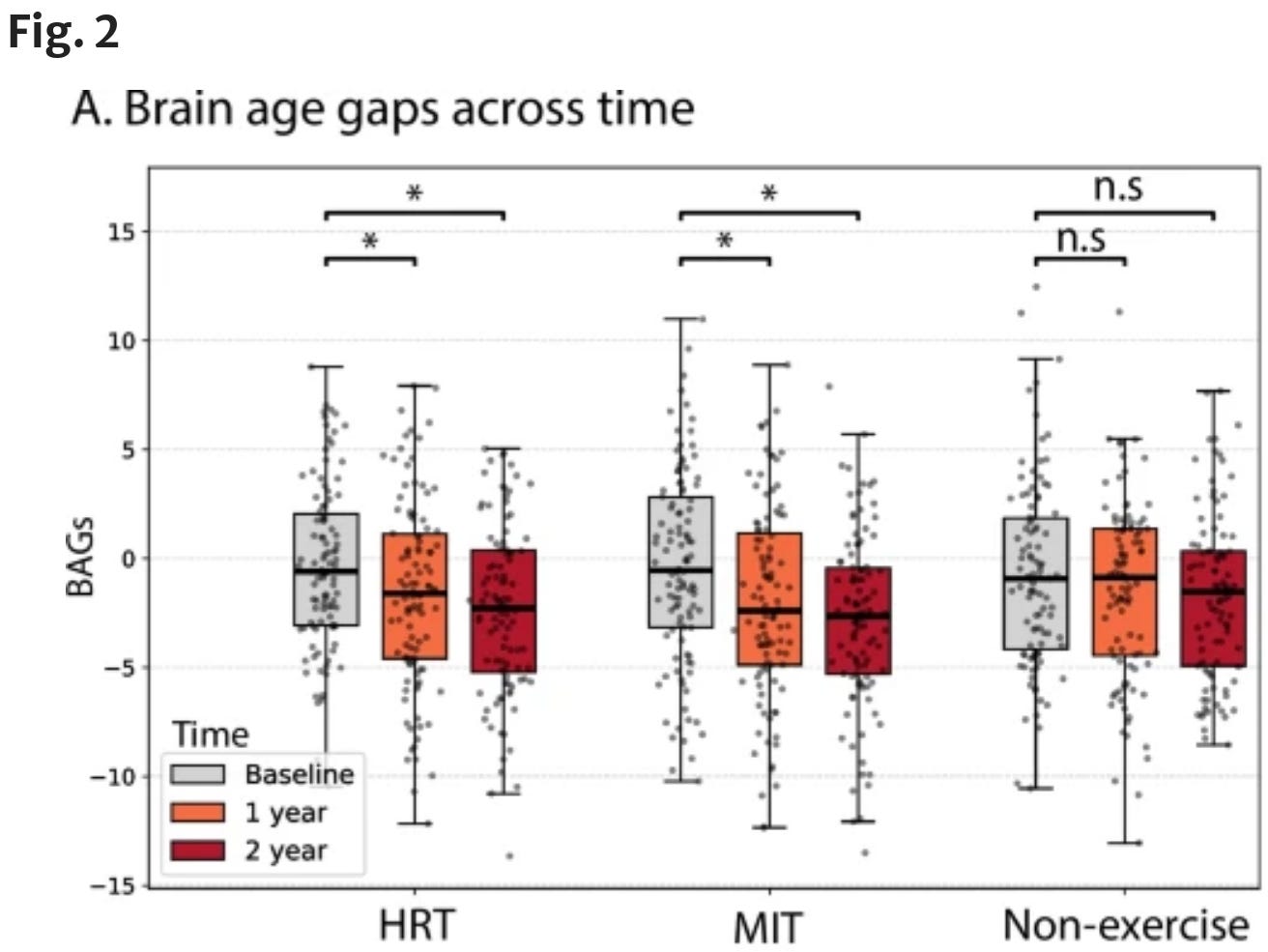
In the box and whisker plots above, the thick horizontal line in the middle of each box represents the median of brain age gaps (i.e. the middle value of the data set), the upper and lower sides of the box represent the 75th and 25th percentile of values respectively, and the ‘whiskers’ extending from the box represent the maximum and minimum values (excluding outliers). Any value above the horizontal 0 line means that the brain looks older than same-age peers, while values below that line indicate a younger-looking brain than other people of the same chronological age.
At baseline, participants in all three groups had slightly younger-looking brains than their same-age peers. By the end of the first year of the study, the brains of participants assigned to heavy resistance training looked 1.42 years younger, while the brains of those assigned to moderate intensity training looked 1.39 years younger. At two-year follow-up (that is, one year after the exercise interventions had ended), the heavy resistance training groups’ brains looked 1.84 years younger, while the moderate training groups’ brains looked 2.26 years younger.
Meanwhile, there were no significant changes in the brain age gap of the non-exercise group, meaning that their brains were continuing to age at the expected rate for people of their chronological age.
Importantly, both moderate and heavy resistance training exerted brain-wide benefits:
“Exercise-related changes in functional connectivity [31] extended beyond specific brain regions, reflecting global improvements in brain health. These findings highlight resistance training as a key modifiable lifestyle factor [1, 4, 31,32,33] capable of delaying brain aging and supporting healthy brain function later in life [34, 35].”
Randomized controlled trial of resistance exercise and brain aging clocks
As for how resistance training slows down brain aging, it probably all comes down to neuroplasticity (as discussed in Rewiring the traumatised brain), which is in turn driven by exercise’s effects on cell division in the central nervous system, neuron-to-neuron communication, and blood vessel growth and function, along with the cognitive engagement that is required to actually perform the exercises:
“Exercise promotes plasticity through synaptic, angiogenic, neurotrophic, and vascular mechanisms [1, 31, 32, 38]. The prefrontal cortex likely reflects the local expression of this global phenomenon, where cognitive engagement during exercise further reinforces executive networks [37, 39, 40].”
Randomized controlled trial of resistance exercise and brain aging clocks
Hitting the sweet spot
Crucially, the researchers noted evidence from their own study, and other research, that there is “a non-linear dose–response relationship between exercise and BAG [brain age gap] reduction [47], in which greater training exposure does not necessarily yield proportionally greater brain benefits.”
In other words, there is likely a ceiling, above which the benefits of resistance training begin to attenuate, and even reverse. This jibes with the “sweet spot” of 150-390 minutes of physical activity per week, that was found in the study that I summarised in Rewiring the traumatised brain.
It’s also in alignment with recent findings of “a J-shaped relationship between RET [resistance exercise training] duration and mortality risk”, particularly with high intensity training:
“High-intensity RET at >70% one-repetition maximum (1-RM) has been shown to increase arterial stiffness,45,46 a risk factor for cardiovascular disease and significant contributor to all-cause mortality.47 Additionally, RET has been associated with left ventricular hypertrophy, which can also increase cardiovascular risk.48 Intermittent, acute elevations in blood pressure during RET, and increased sympathetic nervous system activity, might contribute to these structural and functional changes in the heart and arteries.46,48,49 However, chronic low-intensity RET (<50% 1RM) may not produce these adverse effects on arterial stiffness, indicating that training intensity is an important variable.45,46,50”
The Need for Upper Limits in Physical Activity Guidelines: A Narrative Review
The moral of the story
Engaging in regular resistance training is one of the most impactful actions you can take to keep your brain healthy as you age. And you don’t need to become a gym junkie to reap the benefits of resistance exercise. At least in this population of older Danish adults, bodyweight exercises and resistance bands kept participants’ brains young, at least as well as weights machines in the gym.
And if you do love to lift heavy, be mindful of that J-shaped curve: more is not necessarily better when it comes to high intensity weight training.
And if you want to ditch Substack and get my posts straight from the source - as well as commenting and viewing any content that Substack won’t let you see without using their privacy-invading facial recognition app - just